
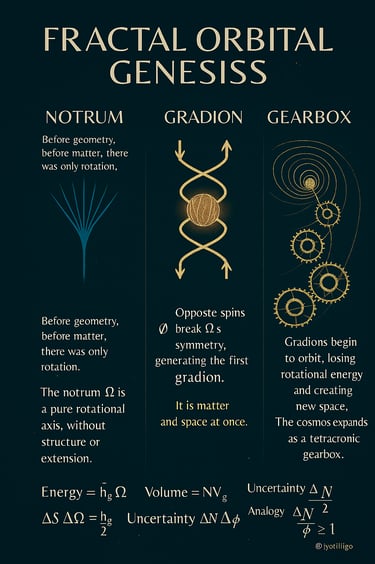
Tetracronic Fractal Genesis — The Birth of Space from Spin Coupling
Prologue: Before Geometry
Before there was form, there was motion — infinite, directionless, unbound.
It was not energy nor matter, but pure kinetic chaos: every point moving at immeasurable speed, with no reference, no duration, no space to contain it.
In that timeless sea, the seed of form was hidden — not as a particle, but as a possibility of slowing down.
“Space is not the container of motion; it is the shadow that motion leaves when it begins to slow.”
1. The Primordial Chaos
At t→0:


Motion was everywhere, yet nowhere stable.
Vortices appeared and dissolved instantly.
Then — by coincidence or necessity — two opposing spins emerged close enough to interact.


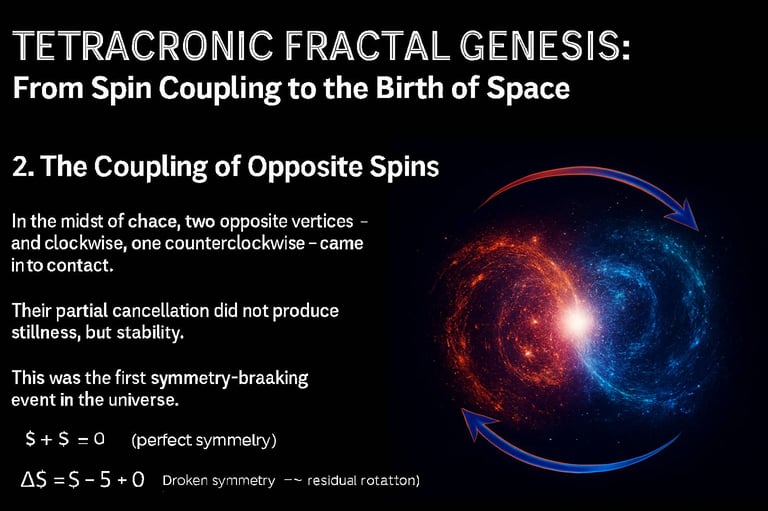
2. The Coupling of Opposite Spins
One vortex turned right, the other left.
Their encounter did not end motion — it organized it.
The partial cancellation of their spins produced a small remainder:
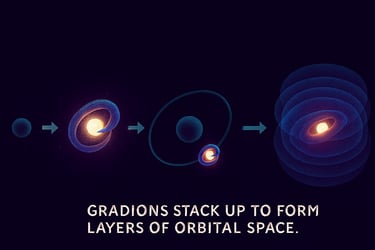
This residual rotation became the first stable entity — the gradion.
It was not matter yet, but the geometry of persistence, a nucleus of ordered motion capable of attraction.
Here, symmetry broke, and with it, the possibility of structure was born.


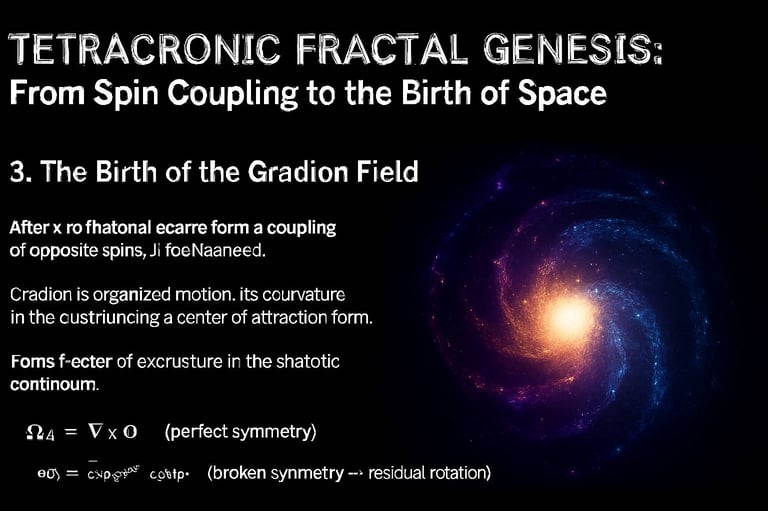
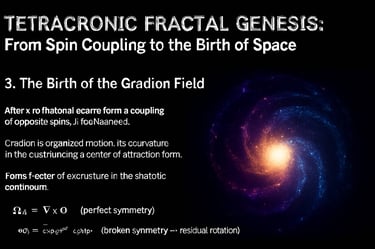
3. The Gradion Field: Motion Organizes Itself
The gradion created a rotational field in four dimensions:


Around this seed, the chaotic continuum began to bend.
Trajectories folded into orbits, and velocity gradients emerged:

The exponential decay of spin marks the first law of spatial genesis:
“Every reduction of rotation becomes an extension in space.”
4. From Spin to Space
Where rotation slows, structure appears.
Rotational energy transforms into measurable distance:
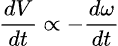
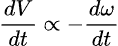
Space, therefore, is not emptiness — it is motion slowed enough to persist.
Each orbit becomes a new layer of existence, a shell of stability emerging from chaos.
5. The Fractal Cascade
Each orbital structure repeats the process at smaller scales:


This recursive law produces a fractal hierarchy of orbits —
the Orbital Fractal Field.
Every layer slows the next, forming a cosmic gearbox where motion is continually transformed into geometry.


6. The Dissipative Field Equation
The dynamic equilibrium between coupling and dissipation is expressed as:


The resulting state — a luminous rotational core — is the first spatial field:
stability born from balanced dissipation.


Stable configurations arise when spin retention equals energy loss:
7. Dimensional Curvature
The gradient of angular velocity defines the curvature of the emerging continuum:


Each velocity gradient weaves curvature into the tetracronic fabric.
Space becomes not an external container, but the field of differential rotation itself.


8. The Four-Dimensional Spiral
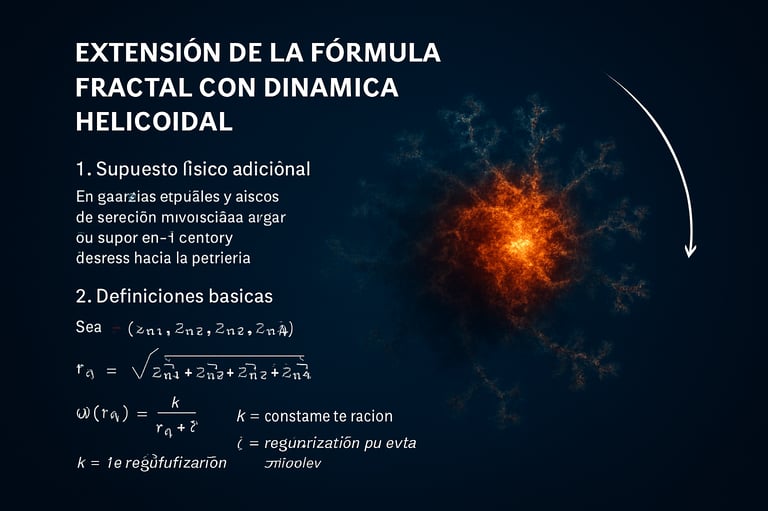
Parametric form of the 4D orbit:


As r grows, w decreases — outer layers rotate slower.
The 3D projection of this 4D geometry appears as a spiral,
but the spiral is merely the shadow of a deeper rotational decay.

9. The Orbital Universe
From the coupling of spins to the cascade of orbits,
the Tetracronic Universe emerges as a Fractal Gearbox of Motion:


Every galaxy, every atom, every vortex is an echo of that first event —
a self-similar conversion of motion into space, of spin into structure.
Every galaxy, every atom, every vortex is an echo of that first event —
a self-similar conversion of motion into space, of spin into structure.
10. Epilogue: The Memory of Motion
Space is not a stage — it is a process.
It remembers the slowing of chaos, the first coupling of opposites.
Every orbit, every wave, every atom is a fossil of the primordial slowdown.
Existence itself is the echo of that first equilibrium —
where motion became memory, and memory became form.
Dimensión
Exploreing geometry of fourth dimension.
Math
space
avcesar58@hotmail.com
© 2025. All rights reserved.