The Gradion: Fundamental Quantum of Tetrachronic Space
1. Origin of the Concept
The term gradion comes from the idea of a gradual quantum — a discrete unit of spatial assembly produced by the coupling of opposite spins in the fourth coordinate w.
In the Tetracronic framework, space is not continuous; it is composed of tiny four-dimensional quanta that appear each time a pair of counter-rotating spin waves achieve coherent phase coupling.
Each successful coupling event produces one gradion, analogous to how an energy quantum (a photon) emerges from the oscillation of an electromagnetic field.



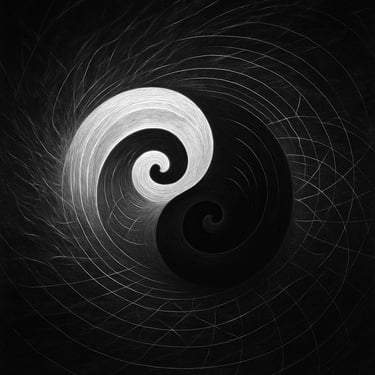
Thus, the first matter can be seen as the first condensation of gradions, arising from the primordial spin equilibrium — the Yin–Yang symmetry at the origin of the universe.
2. Mathematical Definition
Each gradion corresponds to a discrete packet of four-dimensional volume Vg created when the coupling energy exceeds the minimum threshold:


The gradion number generated by a local coupling is given by:


where:
η→ assembly efficiency (0 < η ≤ 1)
ℏg→ gradional constant (quantum of action in 4D)
Ω0→ minimum assembly frequency of the space field
ΔEcoupling → available coupling energy between opposite spins
Each gradion contributes a discrete 4-volume Vg, so the total assembled region is:


3. Physical Interpretation
In geometric terms, a gradion can be viewed as the 4D equivalent of a Planck voxel — the smallest measurable spatial entity in the tetrachronic continuum.
Its internal symmetry is inherited from the spin pairing that created it: one right-handed component and one left-handed, locked in a dynamic equilibrium along the w-axis.
Conceptually:
The spin coupling provides angular coherence.
The gradional constant ℏg\hbar_gℏg sets the quantum limit of spatial formation.
The frequency Ω0\Omega_0Ω0 determines the rate at which 4D volumes emerge from the vacuum.
Together, these define the quantum geometry of space — a lattice of interlinked gradions forming the structure of the Tetracron itself.


4. Extended Notation Summary
5. Conceptual Visualization
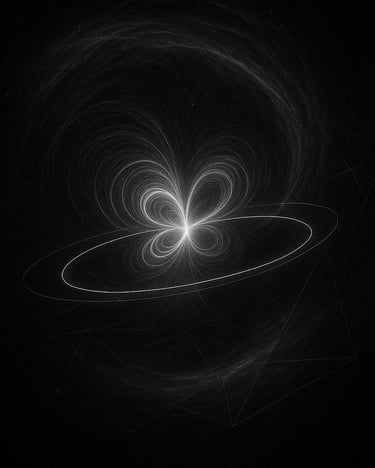
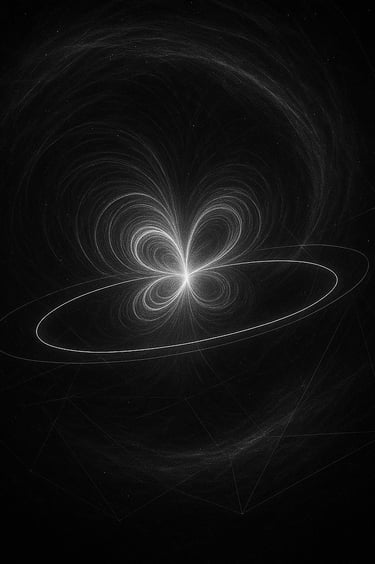
If one could “see” a gradion, it would appear not as a static sphere but as a rotational interference pattern — a 4D oscillatory pulse, forming a toroidal-spherical volume that constantly exchanges spin flux across the fourth coordinate.
In this vision, dark matter itself could be interpreted as a sea of unbound gradions, invisible in 3D but geometrically active in 4D, sustaining the curvature of the cosmic fabric.
6. Summary
A gradion is the elementary unit of space in the Tetracron model —
born from the quantum coupling of two opposite spins,
stabilized by the gradional constant ℏg,
and expressed as a finite four-dimensional volume Vg.
It is both a particle of geometry and a quantum of existence, the first breath of space in the dance of the primordial Yin and Yang.
Dimensión
Exploreing geometry of fourth dimension.
Math
space
avcesar58@hotmail.com
© 2025. All rights reserved.